Believe it or not, it actually took awhile for the Grand Canyon to attain National Park status. The area first came under Federal jurisdiction in 1893 as a Game Preserve; later it was “promoted” to National Monument. But this wasn’t enough to protect the immense chasm from people who wanted to exploit it. Miners, loggers, ranchers and other like-minded individuals labored, dreamed and schemed in an effort to make a buck off the Grand Canyon’s natural resources. But at the end of the day, they always seemed to find a rather large obstacle standing in their way of their getting rich: the Grand Canyon itself. Its steep cliffs, often inhospitable climate and extreme remoteness had a maddening tendency to negate any profit to be had from extracting its minerals, harvesting its trees, or letting cows graze in its forests. Fortunately these endeavors were mostly abandoned by the dawn of the 20th century in favor of a far more profitable and less labor-intensive pursuit: tourism.
Peter Berry was one such individual who “saw the light.” Originally seeking his fortune through mining, Berry was responsible for the construction of the Grandview Trail, which led to his Last Chance Copper Mine on Horseshoe Mesa. In 1897, he built the Grandview Hotel. This would be the first true tourist destination at Grand Canyon’s South Rim and would flourish for a time as a welcome retreat for travelers who had endured the back-breaking (and expensive at $20 a head) 12-hour stagecoach ride from Flagstaff. Around the same time, and approximately 6 miles West of the Grandview, other erstwhile prospectors began trying their hand at the tourism business. James W. Thurber built a small lodge and put up some tent cabins on the canyon rim, an endeavor which was called the “Bright Angel Hotel.” These would be the modest beginnings of Grand Canyon Village. Meanwhile, Ralph Cameron also built a hotel and staked his claim to an old Indian trail to the bottom of the Grand Canyon, charging a fee to anyone who wished to walk or ride down it to his Indian Gardens Campground 5 miles from the top. Known then as the “Bright Angel Toll Road,” it would later become the “Bright Angel Trail,” the toll having been done away with. Louis Boucher, nicknamed “The Hermit” even though he was a sociable fellow, established a tourist camp and gardens 8 miles West of the Bright Angel Toll Road. Many private parties competed fiercely for the Grand Canyon tourist’s dollar back in the olden days, to the point where an “urban legend” surfaced which maintained that a visitor’s coat was once ripped in half by two hoteliers hawking their respective properties!
In 1901, all that began to change when the Atchison Topeka and Santa Fe Railroad completed a spur line from Williams, Arizona to the South Rim of the Grand Canyon. This made the journey to the Grand Canyon a comfortable and, dare we say, civilized experience of a mere three hours in length. The advent of more feasible means of getting to the park signaled the need for services such as hotels and restaurants at the track’s end at the nascent Grand Canyon Village. Construction soon began on the first large-scale Grand Canyon hotel, with financing from the Santa Fe: the El Tovar. Designed by Charles Whittlesey, the El Tovar evokes a feeling of opulence with earthy undertones, with architectural details culled from Swiss ski chalets and Norwegian hunting villas such as dark-varnished log beams, oversized fireplaces and vaulted ceilings. British-born hotelier Fred Harvey was contracted to run the hotel, bringing his unique business sense, city-bred efficiency, and his famous Harvey Girls to Grand Canyon National Park.
The smaller hotels could not compete with the El Tovar and its railroad money. The Grandview Hotel managed to hang on until 1908, but it too would eventually be dismantled. Today, one can still see a few remnant of the Grandview Hotel, such as old pipes and a cistern, by walking down an unmarked road half a mile East of Grandview Point. In what was perhaps an early example of recycling, about 25 years after the Grandview Hotel’s closure, some of its logs were hauled 20 miles East and incorporated into a new building: the Desert View Watchtower. A recreation of an ancient Puebloan ruin found at Hovenweep National Monument, the Desert View Watchtower was designed by one of America’s first prominent female architects, Mary Jane Colter.
Colter would go on to become an integral part of Grand Canyon National Park’s early development, as she was commissioned to design the park’s second railway-financed hotel, the Bright Angel Lodge in the 1930’s. Like the El Tovar, the interior design of Bright Angel Lodge is rustic, with whole log beams and large fireplaces. It is painted in a lighter shade of varnish than the El Tovar. Some of its exterior features such as stone masonry walls appear more “free-form” as well, therefore the atmosphere is decidedly more casual. The Bright Angel Lodge would offer some of the park’s most reasonably priced accommodations, including quaint cabins just steps from the canyon rim.
By this time, Grand Canyon National Monument had become Grand Canyon National Park. As it captivated the imagination of the country – including no less than President Theodore Roosevelt – greater federal protection was sought for the place where the heart of the earth had been laid bare. In 1919, Grand Canyon National Park officially came to be. In 1975, federal legislation would extend the boundaries of Grand Canyon National Park to the Grand Wash Cliffs to the West and Lees Ferry to the east, effectively doubling the size of the park. By then, four other lodges had been built inside Grand Canyon National Park at the South Rim, and the community of Tusayan would established itself as a “gateway city” with five hotels of its own.
Today, the Grand Canyon is “the sum of its parks.” Grand Canyon National Park plays host to 5 million visitors annually, but it also competes for – and sometimes shares – its slice of the “tourism pie” with other areas of the Grand Canyon owned by Native American Tribal interests: Grand Canyon West, owned by the Hualapai Indian Tribe; Havasu Canyon, owned by the Supai Indian Tribe (presently closed due to flooding); and the extreme Eastern end of the Grand Canyon owned by the Navajo Indian Tribe. Whichever side, or sides, one chooses to visit it from, the Grand Canyon is a place that inexplicably draws people to it, gets in their blood, and leaves them with a yearning to return, usually bringing their children with them.
5 Responses
I am interested in seeing the actual site of the Grandview Hotel in GCNP. Have you been there and if so, can you give landmarks to find it.
History buff,
Paul Schweitzer
Paul,
This is a fun one. The Interpretive Sign provided by the National Park Service at Grandview Point…I believe…gives you some point of reference as to where it was located when you are there. My approximation, if my memory serves me correctly, is about where the Upper Parking Lot is located today. I have taken a Google Maps screen grab to show you where I believe the Grandview Hotel was located:
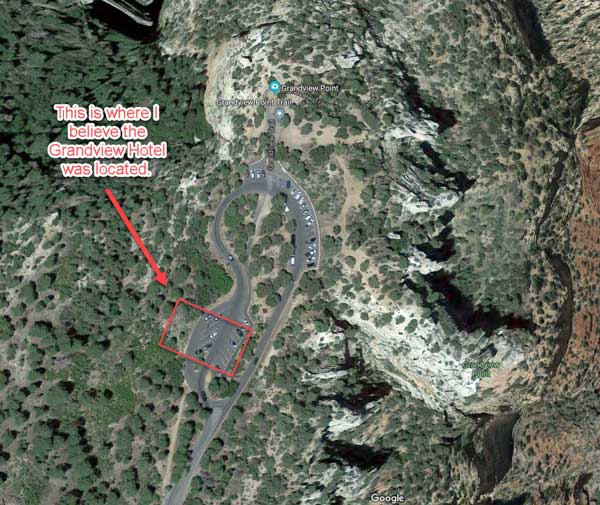
Now, my first detailed orientation to Grandview is in the book, “Living at the Edge” by Michael F. Anderson. Great book! I like Michael Anderson too…he led a guided, informative tour at one of the Symposium’s I attended at the South Rim some years back down to the 2nd Tunnel on the Bright Angel Trail. Pete Berry’s history is from Page 67-76, or so. There’s some good photo’s in there that might help you place it’s location, as well. Here’s a link to that book on Amazon: https://www.amazon.com/Living-Edge-Explorers-Exploiters-Association/dp/0938216554/
Sorry, couldn’t find it on the Grand Canyon Conservancy’s site…I actually bought it in their Giftshops on the Rim too.
I remember walking around this area and believe I saw some remnants of what might have been the foundation for the Grandview Hotel, as well.
Also, here is a link to the Short History on NPS.gov:
https://www.nps.gov/grca/learn/historyculture/miners.htm
I was planning to be on the Grandview Trail next week…however, it’s getting too hot for my liking to go into the Canyon…so maybe this Fall.
I hope this helps you with your History research.
I happen to love Grand Canyon History too…we just had the 100th Year Grand Canyon History Symposium at Shrine of the Ages during Snowgeddon in February.
Enjoy,
Karlyn
You’re. Abit off. The historic GV Hotel was not even along the current alignment of the rim road. It was east of Grandview Point Road and right on the rim.
Schist,
You’re probably right as I look at the Original Photographs again…I just always notice those cement foundations that cut through the parking area there and assumed that’s where they were. Thank you for the correction!
Thank You,
Karlyn
Hello! My wife and I live in and work for GRCA and after a tip by one of our supervisors, we were able to find the ruins. Here’s a clue – it’s about .5 miles east of grand view point and next to a pull off, there’s a sign that says “road closed to all vehicles, foot travel only”
Happy exploring!